

Article Sidebar
Downloads
Main Article Content
Abstract
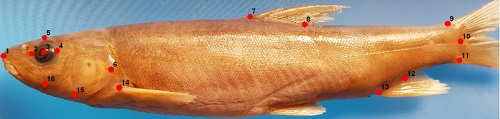
The present study employed geometric morphometric analysis to investigate morphological variation of a cyprinid fish Schizocypris altidorsalis from the Hamun–Hirmand aquatic system in the Sistan Basin, southeastern Iran. A total of 55 specimens (26 from the Chahnimeh reservoirs and 29 from the Hamun wetland) were collected using hand and cast nets. Sixteen homologous landmarks were digitized from two-dimensional images of each specimen using TPSDig2 software. Shape variation was analyzed using Generalized Procrustes Analysis (GPA), followed by Principal Component Analysis (PCA), Discriminant Function Analysis (DFA), and Hotelling’s T² test. The DFA revealed significant morphological differentiation between the two populations. Wireframe deformation analysis based on the consensus configuration indicated that the primary differences were associated with body depth and caudal peduncle length. These findings suggest that S. altidorsalis exhibits habitat-associated morphological plasticity, likely reflecting phenotypic responses to contrasting environmental conditions within the Hamun–Hirmand aquatic system.
Keywords
Article Details

This work is licensed under a Creative Commons Attribution-NonCommercial-NoDerivatives 4.0 International License.
The authors transfer the copyrights of their papers to the Iranian Society of Ichthyology. However, the information could be used in accordance with the Creative Commons licence (Attribution-NonCommercial 4.0 International (CC BY-NC 4.0)
References
- Acar, E. & Kaymak, N., 2023. Morphological and functional trait divergence in endemic fish populations along the small-scale karstic stream. BMC Zoology 8(1): 29.
- Coad, B.W. 2013. Freshwater fishes of Iran. Available at: www.briancoad.com.
- Eagderi, S.; Esmaeilzadegan, E. & Madah, A. 2013. Body shape variation in riffle minnows (Alburnoides eichwaldii De Filippii, 1863) populations of Caspian Sea basin. Taxonomy and Biosystematics 5(14): 1-8.
- Gammanpila, M.; Amarasinghe, U. & Wijeyaratne, M. 2017. Morphological correlates with diet of fish assemblages in brush park fisheries of tropical estuaries. Environmental Biology of Fishes 100(10): 1285-1299.
- Ganjali, Z. & Ghorbani, M. 2025. Investigation habitat preference of Anjak, Schizocypris altidorsalis (Bianco and Banarescu, 1982) from the Flood Embankment of Hamun Wetland in the Sistan Basin. Environment and Interdisciplinary Development. In Press. https://doi.org/10.22034/envj.2025.537044.1530
- Ganjali, Z. 2023. Comparative survey of geometric morphometrics and traditional methods in male and female of Anjak, Schizocypris altidorsalis (Bianco and Banarescu, 1982) from Sistan Basin, Iran. Current Applied Sciences 3(1): 21-28.
- Ganjali, Z.; Esmaeili, H.R.; Eagderi, S. & Gholamhosseini, A. 2021. Can geometric morphometrics and traditional methods work for evaluation of body shape plasticity of exotic fishes? A case study of topmouth gudgeon, Pseudorasbora parva (Teleostei: Gobionidae). Iranian Journal Ichthyology 8(3): 250-270.
- Geiger, M.F.; Schreiner, C.; Delmastro, G.B. & Herder, F. 2016. Combining geometric morphometrics with molecular genetics to investigate a putative hybrid complex: a case study with barbels Barbus spp. (Teleostei: Cyprinidae). Journal of Fish Biology 88(3): 1038-1055.
- Ghanbari, M.; Jami, M.; Shahraki, H. & Domig, K.J. 2019. Characterization of the gut microbiota in the Anjak (Schizocypris altidorsalis), a native fish species of Iran. BioRxiv 735241.
- Gholami, S.; Keivany, Y. & Jafari Patkan, A. 2025. Comparing the morphological diversity of northern Caucasian bleak (Alburnus hohenackeri) in Sistan basin. Journal of Fisheries pp. 2423-7809.
- Hammer, O.; Harper D.A.T. & Ryan, P.D. 2001. Past: Paleontological statistics software package for education and data analysis. Palaeontologia Electronica 4(4): 1-9
- Keivany, Y.; Nasri, M.; Abbasi, K. & Abdoli, A. 2016. Fishes of Iran. Atlas of inland water, Department of Environment, Tehran, Iran. 218 p.
- Klingenberg C.P. 1998. Heterochrony and allometry: The analysis of evolutionary change in ontogeny. Journal of Biological Reviews 73(1): 79-123.
- Loy, A.; Cataudella, S. & Corti, M. 1996. Shape changes during the growth of the sea bass, Dicentrarchus labrax (Teleostea: Perciformes), in relation to different rearing conditions. In: Advances in Morphometrics. (pp. 399-405). Boston, MA: Springer US.
- Luo, D. 2024. Quantitative Analysis of Fish Morphology through Landmark and Outline-based Geometric Morphometrics with Free Software. Bio-protocol 14(20).
- Martin, B.E.; O'Malley, B.; Eshenroder, R.L.; Kao, Y.C.; Olds, C.M.; O'Brien, T.P. & Davis, C.L. 2023. Comparison of traditional and geometric morphometrics using Lake Huron ciscoes of the Coregonus artedi complex. Transactions of the American Fisheries Society 152(3): 296-309.
- Mouludi Saleh, A. & Keivany, Y. 2019. Comparison of Transcaucasian Chub (Squalius turcicus De Filippi, 1865) populations in south-western Caspian Sea basin using geometric morphometric method. Journal of Animal Research (Iranian Journal of Biology) 32(3): 233-243.
- Mouludi-Saleh A. & Keivany, Y. 2018b. Morphometric analysis of Squalius namak Khaefi et al. 2016 in Khaznagh and Ghare-Chai rivers. Sri Lanka Journal of Aquatic Science 23(2): 173-178.
- Mouludi-Saleh, A. & Eagderi, S. 2021. Habitat-associated morphological divergence of Gasterosteus aculeatus in the Southern Caspian Sea Basin. Iranian Journal of Science and Technology, Transactions A: Science 45(1): 121-125.
- Mouludi-Saleh, A. & Keivany, Y. 2018a. Morphological diversity in three species of Chubs (Squalius spp.) populations in Iranian Basins. Nova Biologica Reperta 5(2): 192-204.
- Mouludi-Saleh, A.; Eagderi, S.; Abbasi, K. & Nasri, M. 2022b. Validation of two sympatric fish species of Urmia chub, Petroleuciscus ulanus and Urmia bleak, Alburnus atropatenae, based on morphologic characters in Mahabad-Chai River. Nova Biologica Reperta 8(4): 289-296.
- Mouludi-Saleh, A.; Eagderi, S.; Poorbagher, H. & Kazemzadeh, S. 2019. The effect of body shape type on differentiability of traditional and geometric morphometric methods: A case study of Channa gachua (Hamilton, 1822). European Journal of Biology 78(2): 165-168.
- Mouludi-Saleh, A.; Eagderi, S.; Poorbagher, H. & Mohammadi, S. 2022a. Investigation of morphological variation of Oxynoemacheilus elsae from rivers of the Urmia Lake basin using traditional and geometric morphometric methods. Journal of Applied Ichthyological Research 10(1): 21-30.
- Nasri, M.; Eagderi, S.; Farahmand, H. & Segherloo, I.H. 2013. Body shape comparison of Cyprinion macrostomum (Heckel, 1843) and Cyprinion watsoni (Day, 1872) using geometric morphometric method. International Journal of Aquatic Biology 1(5): 240-244.
- Nasri, M.; Eagderi, S.; Keivany, Y.; Farahmand, H.; Dorafshan, S.; Nezhadheydari, H. 2018.Morphological diversity of Cyprinion Heckel, 1843 species (Teleostei: Cyprinidae) in Iran. Iranian Journal of Ichthyology 5(2): 96-108.
- Radkhah, A.; Poorbagher, H. & Eagderi, S. 2016. Investigation of morphological differences of Capoeta capoeta populations in the upstream and downstream of Zarinerood River in Urmia Lake Basin. Journal of Animal Environment 8(3): 167-74.
- Rahdari, A. 2019. Role of Chahnimeh reservoirs in preserving the native fish of Seistan region. International Conference on dust storms in Southwestern Asia, Zabol, Iran, April 23-25.
- Razavipour, P.; Eagderi, S.; Poorbagher, H.; Javanshir Khooi, A. & Keivany Y. 2015. Comparative study of morphological characteristics of Tuini fish (Capoeta damascina) in inland water of Iran using geometic morphometric method. Journal of Fisheries 8(1): 79-90.
- Rohlf, F.J. & Bookstein, F.L. (Eds). Proceedings of the Michigan Morphometrics Workshop. Museum of Zoology special publication no. 2, University of Michigan, Ann Arbor. 1990.
- Salehinia, D.; Eagderi, S.; Khorasani, NA. & Zamani-Faradonbeh, M. 2016. Impact of Sangban Dam on the morphologicl chaactrestics of Siah mahi (Capoeta gracilis, keyserling, 1864) populations using traditional and geometric morphometrics techniques. Journal of Animal Environment 8(2): 97-104.
- Sansom, R.S. 2009. Phylogeny, classification, and character polarity of the Osteostraci (Vertebrata). Journal of Systematic Paleontology 7(1): 95-115.
- Sayyadzadeh, G. & Esmaeili, H.R. 2024. Freshwater lamprey and fishes of Iran: Reappraisal and updated checklist with a note on Eagderi et al. (2022). Zootaxa 5402(1): 001-099.
- Shamsi, S.; Khedri, J.; Borji, H.; Suthar, J. & Francis, N. 2024. Gill parasites of Schizocypris altidorsalis (Pisces: Cyprinidae), a threatened freshwater fish in Iran. Marine and Freshwater Research 75(6): MF23251.
- Shuai, F.; Yu, S.; Lek, S. & Li, X. 2018. Habitat effects on intra‐species variation in functional morphology: Evidence from freshwater fish. Ecology and Evolution 8(22): 10902-10913.
- Slice, D.E. 2005. Modern morphometrics. In: Modern morphometrics in physical anthropology. Springer US, Boston, MA, pp. 1-45.
- Smith, T.B. & Skulason, S. 1996. Evolutionary significance of resource polymorphisms in fishes, amphibians and birds. Annual Review of Ecology and Systematics Journal 27(1): 111-133.
- Su, G., Villeger, S., Brosse, S., 2019. Morphological diversity of freshwater fishes differs between realms, but morphologically extreme species are widespread. Global Ecology and Biogeography 28(2): 211-221.
- Tadesse, H. & Lakew, A. 2025. Fish composition and their habitat preferences in human impacted tributaries of the upper Awash River, Ethiopia. Fisheries and Aquatic Sciences 28(6), 396-405.
- Turan, C.; Erguden, D.; Gurlek, M. & Turan, F. 2004. Morphometric structuring of the Anchovy (Engraulis encrasicolus) in the Black, Aegean and Northeastern Mediterranean Seas. Turkish Journal of Vertebrate Animal Sciences 28(5): 865-871.
- Zamani Faradonbeh, M.; Eagderi, S. & Nasri, M. 2014. Geometrics morphometric comparison of populations of waspi Cabdio morar (Hamilton, 1822) in Mashkid and Mokran basins. Iranian Scientific Fisheries Journal 23(2): 57-67.
References
Acar, E. & Kaymak, N., 2023. Morphological and functional trait divergence in endemic fish populations along the small-scale karstic stream. BMC Zoology 8(1): 29.
Coad, B.W. 2013. Freshwater fishes of Iran. Available at: www.briancoad.com.
Eagderi, S.; Esmaeilzadegan, E. & Madah, A. 2013. Body shape variation in riffle minnows (Alburnoides eichwaldii De Filippii, 1863) populations of Caspian Sea basin. Taxonomy and Biosystematics 5(14): 1-8.
Gammanpila, M.; Amarasinghe, U. & Wijeyaratne, M. 2017. Morphological correlates with diet of fish assemblages in brush park fisheries of tropical estuaries. Environmental Biology of Fishes 100(10): 1285-1299.
Ganjali, Z. & Ghorbani, M. 2025. Investigation habitat preference of Anjak, Schizocypris altidorsalis (Bianco and Banarescu, 1982) from the Flood Embankment of Hamun Wetland in the Sistan Basin. Environment and Interdisciplinary Development. In Press. https://doi.org/10.22034/envj.2025.537044.1530
Ganjali, Z. 2023. Comparative survey of geometric morphometrics and traditional methods in male and female of Anjak, Schizocypris altidorsalis (Bianco and Banarescu, 1982) from Sistan Basin, Iran. Current Applied Sciences 3(1): 21-28.
Ganjali, Z.; Esmaeili, H.R.; Eagderi, S. & Gholamhosseini, A. 2021. Can geometric morphometrics and traditional methods work for evaluation of body shape plasticity of exotic fishes? A case study of topmouth gudgeon, Pseudorasbora parva (Teleostei: Gobionidae). Iranian Journal Ichthyology 8(3): 250-270.
Geiger, M.F.; Schreiner, C.; Delmastro, G.B. & Herder, F. 2016. Combining geometric morphometrics with molecular genetics to investigate a putative hybrid complex: a case study with barbels Barbus spp. (Teleostei: Cyprinidae). Journal of Fish Biology 88(3): 1038-1055.
Ghanbari, M.; Jami, M.; Shahraki, H. & Domig, K.J. 2019. Characterization of the gut microbiota in the Anjak (Schizocypris altidorsalis), a native fish species of Iran. BioRxiv 735241.
Gholami, S.; Keivany, Y. & Jafari Patkan, A. 2025. Comparing the morphological diversity of northern Caucasian bleak (Alburnus hohenackeri) in Sistan basin. Journal of Fisheries pp. 2423-7809.
Hammer, O.; Harper D.A.T. & Ryan, P.D. 2001. Past: Paleontological statistics software package for education and data analysis. Palaeontologia Electronica 4(4): 1-9
Keivany, Y.; Nasri, M.; Abbasi, K. & Abdoli, A. 2016. Fishes of Iran. Atlas of inland water, Department of Environment, Tehran, Iran. 218 p.
Klingenberg C.P. 1998. Heterochrony and allometry: The analysis of evolutionary change in ontogeny. Journal of Biological Reviews 73(1): 79-123.
Loy, A.; Cataudella, S. & Corti, M. 1996. Shape changes during the growth of the sea bass, Dicentrarchus labrax (Teleostea: Perciformes), in relation to different rearing conditions. In: Advances in Morphometrics. (pp. 399-405). Boston, MA: Springer US.
Luo, D. 2024. Quantitative Analysis of Fish Morphology through Landmark and Outline-based Geometric Morphometrics with Free Software. Bio-protocol 14(20).
Martin, B.E.; O'Malley, B.; Eshenroder, R.L.; Kao, Y.C.; Olds, C.M.; O'Brien, T.P. & Davis, C.L. 2023. Comparison of traditional and geometric morphometrics using Lake Huron ciscoes of the Coregonus artedi complex. Transactions of the American Fisheries Society 152(3): 296-309.
Mouludi Saleh, A. & Keivany, Y. 2019. Comparison of Transcaucasian Chub (Squalius turcicus De Filippi, 1865) populations in south-western Caspian Sea basin using geometric morphometric method. Journal of Animal Research (Iranian Journal of Biology) 32(3): 233-243.
Mouludi-Saleh A. & Keivany, Y. 2018b. Morphometric analysis of Squalius namak Khaefi et al. 2016 in Khaznagh and Ghare-Chai rivers. Sri Lanka Journal of Aquatic Science 23(2): 173-178.
Mouludi-Saleh, A. & Eagderi, S. 2021. Habitat-associated morphological divergence of Gasterosteus aculeatus in the Southern Caspian Sea Basin. Iranian Journal of Science and Technology, Transactions A: Science 45(1): 121-125.
Mouludi-Saleh, A. & Keivany, Y. 2018a. Morphological diversity in three species of Chubs (Squalius spp.) populations in Iranian Basins. Nova Biologica Reperta 5(2): 192-204.
Mouludi-Saleh, A.; Eagderi, S.; Abbasi, K. & Nasri, M. 2022b. Validation of two sympatric fish species of Urmia chub, Petroleuciscus ulanus and Urmia bleak, Alburnus atropatenae, based on morphologic characters in Mahabad-Chai River. Nova Biologica Reperta 8(4): 289-296.
Mouludi-Saleh, A.; Eagderi, S.; Poorbagher, H. & Kazemzadeh, S. 2019. The effect of body shape type on differentiability of traditional and geometric morphometric methods: A case study of Channa gachua (Hamilton, 1822). European Journal of Biology 78(2): 165-168.
Mouludi-Saleh, A.; Eagderi, S.; Poorbagher, H. & Mohammadi, S. 2022a. Investigation of morphological variation of Oxynoemacheilus elsae from rivers of the Urmia Lake basin using traditional and geometric morphometric methods. Journal of Applied Ichthyological Research 10(1): 21-30.
Nasri, M.; Eagderi, S.; Farahmand, H. & Segherloo, I.H. 2013. Body shape comparison of Cyprinion macrostomum (Heckel, 1843) and Cyprinion watsoni (Day, 1872) using geometric morphometric method. International Journal of Aquatic Biology 1(5): 240-244.
Nasri, M.; Eagderi, S.; Keivany, Y.; Farahmand, H.; Dorafshan, S.; Nezhadheydari, H. 2018.Morphological diversity of Cyprinion Heckel, 1843 species (Teleostei: Cyprinidae) in Iran. Iranian Journal of Ichthyology 5(2): 96-108.
Radkhah, A.; Poorbagher, H. & Eagderi, S. 2016. Investigation of morphological differences of Capoeta capoeta populations in the upstream and downstream of Zarinerood River in Urmia Lake Basin. Journal of Animal Environment 8(3): 167-74.
Rahdari, A. 2019. Role of Chahnimeh reservoirs in preserving the native fish of Seistan region. International Conference on dust storms in Southwestern Asia, Zabol, Iran, April 23-25.
Razavipour, P.; Eagderi, S.; Poorbagher, H.; Javanshir Khooi, A. & Keivany Y. 2015. Comparative study of morphological characteristics of Tuini fish (Capoeta damascina) in inland water of Iran using geometic morphometric method. Journal of Fisheries 8(1): 79-90.
Rohlf, F.J. & Bookstein, F.L. (Eds). Proceedings of the Michigan Morphometrics Workshop. Museum of Zoology special publication no. 2, University of Michigan, Ann Arbor. 1990.
Salehinia, D.; Eagderi, S.; Khorasani, NA. & Zamani-Faradonbeh, M. 2016. Impact of Sangban Dam on the morphologicl chaactrestics of Siah mahi (Capoeta gracilis, keyserling, 1864) populations using traditional and geometric morphometrics techniques. Journal of Animal Environment 8(2): 97-104.
Sansom, R.S. 2009. Phylogeny, classification, and character polarity of the Osteostraci (Vertebrata). Journal of Systematic Paleontology 7(1): 95-115.
Sayyadzadeh, G. & Esmaeili, H.R. 2024. Freshwater lamprey and fishes of Iran: Reappraisal and updated checklist with a note on Eagderi et al. (2022). Zootaxa 5402(1): 001-099.
Shamsi, S.; Khedri, J.; Borji, H.; Suthar, J. & Francis, N. 2024. Gill parasites of Schizocypris altidorsalis (Pisces: Cyprinidae), a threatened freshwater fish in Iran. Marine and Freshwater Research 75(6): MF23251.
Shuai, F.; Yu, S.; Lek, S. & Li, X. 2018. Habitat effects on intra‐species variation in functional morphology: Evidence from freshwater fish. Ecology and Evolution 8(22): 10902-10913.
Slice, D.E. 2005. Modern morphometrics. In: Modern morphometrics in physical anthropology. Springer US, Boston, MA, pp. 1-45.
Smith, T.B. & Skulason, S. 1996. Evolutionary significance of resource polymorphisms in fishes, amphibians and birds. Annual Review of Ecology and Systematics Journal 27(1): 111-133.
Su, G., Villeger, S., Brosse, S., 2019. Morphological diversity of freshwater fishes differs between realms, but morphologically extreme species are widespread. Global Ecology and Biogeography 28(2): 211-221.
Tadesse, H. & Lakew, A. 2025. Fish composition and their habitat preferences in human impacted tributaries of the upper Awash River, Ethiopia. Fisheries and Aquatic Sciences 28(6), 396-405.
Turan, C.; Erguden, D.; Gurlek, M. & Turan, F. 2004. Morphometric structuring of the Anchovy (Engraulis encrasicolus) in the Black, Aegean and Northeastern Mediterranean Seas. Turkish Journal of Vertebrate Animal Sciences 28(5): 865-871.
Zamani Faradonbeh, M.; Eagderi, S. & Nasri, M. 2014. Geometrics morphometric comparison of populations of waspi Cabdio morar (Hamilton, 1822) in Mashkid and Mokran basins. Iranian Scientific Fisheries Journal 23(2): 57-67.