

Article Sidebar
Downloads
Main Article Content
Abstract
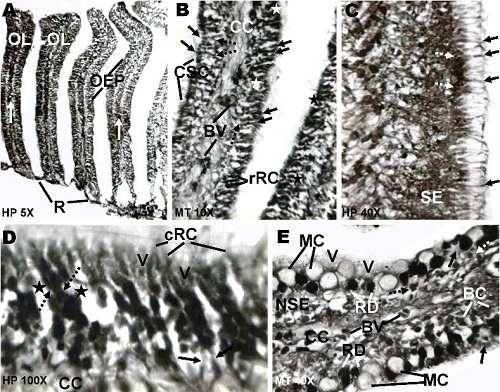
The olfactory organ of the predatory catfish, Mystus gulio (Siluriformes: Ailiidae) was investigated through light microscopy and electron (scanning and transmission) microscopy to elucidate its structural organization. The olfactory rosette was elongated, comprising 32 to 38 lamellae arranged along a central midline raphe. Each olfactory lamella consisted of two principal parts: the olfactory epithelium (mucosa) and the median raphe. The mucosa displayed a clear demarcation into sensory and nonsensory zones, both exhibiting distinct cellular compositions that could be identified based on histoarchitectural features, staining affinities, surface morphology, distributional arrangement and ultrastructural characteristics. The sensory mucosa contained three types of receptor cells: two classical forms bearing either cilia or microvilli, and a third characterized by rod-shaped apical specialization. The nonsensory mucosa comprised mucous cells, chloride-like cells, rodlet cells and mast cells, along with two types of supporting cells categorized as either ciliated or non-ciliated. Basal cells were situated deep within the olfactory mucosa, adjacent to the central core. Structurally, the raphe was formed by compactly arranged stratified epithelial cells exhibiting distinct microridges on the apical membrane. The study discussed the functional relevance of the diverse cell types forming the olfactory mucosa, emphasizing their specific roles in the olfactory perception of Mystus gulio.
Keywords
Article Details

This work is licensed under a Creative Commons Attribution-NonCommercial-NoDerivatives 4.0 International License.
The authors transfer the copyrights of their papers to the Iranian Society of Ichthyology. However, the information could be used in accordance with the Creative Commons licence (Attribution-NonCommercial 4.0 International (CC BY-NC 4.0)
References
- Al-Zahaby, S.A.; Al-Zahaby, A.S.; Mohamed, R.A. & Elsheikh, E.H. 2025. Ultrastructural and developmental anatomy of the peripheral olfactory organs of Dicentrarchus labrax inhabiting Egyptian Mediterranean water. Open Veterinary Journal 15(2): 939-953.
- Anderson T.F. 1951. Techniques for the preservation of three-dimensional structure in preparing specimens for the electron microscope. Transactions of the New York Academy of Sciences 13(4):130-134.
- Atta, K.I. 2013. Morphological, anatomical and histological studies on the olfactory organs and eyes of teleost fish: Anguilla anguilla in relation to its feeding habits. Journal of Basic and Applied Zoology 66(3): 101-108.
- Bandyopadhyay, S.K. & Datta, N.C. 1996. Morphoanatomy and histology of the olfactory organs of air-breathing catfish, Heteropneustes fossilis (Bloch). The Journal of Animal Morphology and Physiology 43(1): 85-96.
- Banerjee, T.K. 1993. Response of fish skin to certain ambient toxicants. In: Singh, B.R. (eds.), Advances in fish research. Narendra Publishing House, Delhi. pp. 185-192.
- Bertmar, G. 1972. Labyrinth cells, a new cell type in vertebrate olfactory organs. Zeitschrift fur Zellforschung und mikroskopische Anatomie 132(2): 245-256.
- Begum, M.; Alam, M.J.; Islam, M.A. & Pal, H.K. 2008. On the food and feeding habit of an estuarine catfish (Mystus gulio Hamilton) in the south-west coast of Bangladesh. University Journal of Zoology Rajshahi University 27: 91-94.
- Bhute, Y.V. & Baile, V.V. 2007. Organization of the olfactory system of the Indian major carp Labeo rohita (Ham.): a scanning and transmission electron microscopy study. Journal of Evolutionary Biochemistry and Physiology 43(3): 342-349.
- Bielek, E. 2005. Development of the endoplasmic reticulum in the Rodlet Cell of two teleost species. Anatomical Record 283(1): 239-249.
- Bozzola, J.J. & Russel, L.D. 1992. Electron microscopy, principles and techniques for biologists. Jones & Bartlett Learning, Burlington.
- Camacho, S.; Ostos-Garrido, M.V.; Domezain, A. & Carmona, R. 2010. Study of the olfactory epithelium in the developing sturgeon characterization of the crypt cells. Chemical Senses 35(2): 147-156.
- Chakrabarti, P. & Ghosh, S.K. 2009. Ultrastructural organisation and functional aspects of the olfactory epithelium of Wallago attu (Bleeker). Folia Morphologica 68(1): 40-44.
- Chen, X. & Arratia, G. 1994. Olfactory organ of Acipenseriformes and comparison with other actinopterygians: patterns of diversity. Journal of Morphology 222(3): 241-267.
- Dymek, J.; Kuciel, M. & Żuwała, K. 2021. Structural diversity of olfactory organs in Osteoglossiformes. Journal of Zoology 314(1): 43-57.
- Dymek, J.; Dymek, A.M.; Kuciel, M. & Żuwała, K. 2024. Macro- and micro morphology of the olfactory organ of African bonytongue, Heterotis niloticus (Cuvier 1829), compared with other species of the family Osteoglossidae (Teleostei). Zoology 163: 126156.
- Farbman, A.I. 1994. The cellular basis of olfaction. Endeavour 18(1): 2-8.
- Fitzgerald, E.F.; Shrestha, S.; Gomez, M.I.; McCaffrey, R.J.; Zimmerman, E.A.; Kannan, K. & Hwang, S. 2012. Polybrominated diphenyl ethers (PBDEs), polychlorinated biphenyls (PCBs) and neuropsychological status among older adults in New York. Neurotoxicology 33(1): 8-15.
- Ghosh, S.K. 2022. Structure and function of the olfactory organ in humped featherback, Chitala chitala (Hamilton, 1822). In: Dey, S.; Sen, K. & Ghosh A.R. (eds.), Sustainable Aquaculture Practices, LAP Lambert Academic Publishing, Republic of Moldova. pp. 22-36.
- Glauert, A.M. 1975. Fixation, dehydration and embedding of biological specimens. Elsevier and North-Holland, New York.
- Gon, O. & Fishelson, L. 2009. Nasal olfactory organs and olfactory bulbs in Blennies. In: Patzner, R.A.; Goncalves, E.J.; Hastings P.H.A. & Kapoor, B.G. (eds.), the biology of Blennies. Science Publishers, Enfield, NH. USA. pp. 118-213.
- Hamdani. E.H. & Døving, K.B. 2007. The functional organization of the fish olfactory system. Progress in Neurobiology 82(2): 80-86.
- Hansen, A.; Anderson, K. & Finger, T.E. 2004. Differential distribution of olfactory receptor neurons in goldfish: structural and molecular correlates. Journal of Comparative Neurology 477(4): 347-359.
- Hara, T.J. 1994. Olfaction and gustation in fish: an overview. Acta Physiologica 152(2): 207-217.
- Hara, T.J. 2000. Chemoreception. In: Ostrander, G.K. (eds.), The laboratory fish. Academic press, London. pp. 471-479.
- Hernádi. L. 1993. Fine structural characterization of the olfactory epithelium and its response to divalent cations Cd2+ in the fish Alburnus alburnus (Teleostei, Cyprinidae): a scanning and transmission electron microscopic study. Neurobiology 1(1): 11-31.
- Ichikawa, M. & Ueda, K. 1977. Fine structure of the olfactory epithelium in the goldfish, Carassius auratus. A study of retrograde degeneration. Cell and Tissue Research 183(4): 445-455.
- Klimenkov I.V.; Pyatov, S.K. & Sudakov, N.P. 2023. Structural and functional features of the olfactory epithelium in fish. Limnology Freshwater Biology 2023(6): 190-203.
- Kuciel, M.; Żuwala, K. & Jakubowski, M. 2011. A new type of fish olfactory organ structure in Periophthalmus barbarous (Oxudercinae). Acta Zoologica 92(3): 276-280.
- Leino, RL. 1974. Ultrastructure of immature, developing and secretory rodlet cells in fish. Cell and Tissue Research 155(3): 367-381.
- Luft, J.H. 1961. Improvements in epoxy resin embedding methods. The Journal of Biophysical and Biochemical Cytology 9(2): 409-414.
- Mallory, F.B. 1936. The aniline blue collagen stain. Stain Technology 11(3): 101.
- Mandal, D.K.; Roy, D. & Ghosh, L. 2005. Structural organization of the olfactory epithelium of a spotted snakehead fish, Channa punctatus. Acta Ichthyologica et Piscatoria 35(1): 45-50.
- Mondal, A. & Mitra, A. 2016. Growth, food and feeding habit with prey preference of long whiskered catfish, Mystus gulio (Hamilton, 1822) in brackishwater traditional impoundments of Sundarban, India. International Journal of Fisheries and Aquatic Studies 4(6): 49-58
- Misra, K.S. 2003. An aid to the identification of the common commercial fishes of India and Pakistan. Narendra Publishing House, New Delhi.
- Mokhtar, D.M. & Abd-Elhafeez, H.H. 2014. Light-and electron-microscopic studies of the olfactory organ of red-tail shark, Epalzeorhynchos bicolor (teleostei: cyprinidae). Journal of Microscopy and Ultrastructure 2(3): 182-195.
- Muller, J.F. & Marc, R.E. 1984. Three distinct morphological classes of receptors in fish olfactory organs. Journal of Comparative Neurology 222(4): 482-495.
- Pol Gerard, 1954. Organe olfactif. Traite de Zoologie 12: 522-533.
- Reite, O.B. 2005. The rodlet cells of teleostean fish: their potential role in host defense in relation to the mast cells/eosinophilic granule cells. Fish & Shellfish Immunology 19(3): 253-267.
- Reite, O.B. & Evensen, Q. 2006. Inflammatory cells of teleostean fish: a review focusing on mast cells/eosinophilic granule cells and rodlet cells. Fish & Shellfish Immunology 20(2): 192-208.
- Ruzhinskaya, N.N.; Gdovskii, P.A. & Devitsina, G. V. (2001). Chloride cells, a constituent of the fish olfactory epithelium. Journal of Evolutionary Biochemistry and Physiology 37(1): 89-94.
- Simpson, K.L. 2018. Olfaction and Taste. In: Haines, D.E. & Mihailoff, G.A. (eds.), Fundamental Neuroscience for Basic and Clinical Applications. Elsevier, Philadelphia. pp. 334-345.
- Suvarna, S.K.; Christopher, L. & Bancroft, J. D. 2019. Bancroft’s theory and practice of histological techniques. 8th Edition. Elsevier, UK.
- Teichmann, H. 1954. Vergleichende Untersuchungen an der Nase der Fische. Zeitschrift für Morphologie und Ökologie der Tiere 43(2): 171-212.
- Theisen, B. 1972. Ultrstructure of the olfactory epithelium in the Australian lungfish, Neoceratodus forsteri, Acta Zoologica 53(2): 205-218.
- Uehara, K.; Miyoshi, M. & Miyoshi, and S. 1991. Cytoskeleton in microridges of the oral mucosal epithelium in the carp (Cyprinus carpio). Anatomical Record 230(2): 164-168.
- Vickers, T. 1962. A study of the intestinal epithelium of the goldfish Carassius auratus: its normal structure, the dynamics of cell replacement and the changes induced by salts of cobalt and manganese. The Quarterly Journal of Microscopical Science 103(s3): 93-110.
- Wakisaka, N.; Miyasaka, N.; Koide, T., Masuda, M.; Hiraki-Kajiyama, T. & 2017. An adenosine receptor for olfaction in Fish. Current Biology 27(10): 1437-1444.
- Yamamoto, M. & Ueda, K. 1977. Comparative morphology of fish olfactory epithelium-I. Salmoniformes. Bulletin of the Japanese Society of Scientific Fisheries 43(10): 1163-1174.
- Yamamoto, M. & Ueda, K. 1978. Comparative morphology of fish olfactory epithelium-III. Cypriniformes. Bulletin of the Japanese Society of Scientific Fisheries 44(11): 1201-1206.
- Yamamoto, M. 1982. Comparative morphology of the peripheral olfactory organ in teleosts. In: Hara, T.J. (eds.), Chemoreception in fishes. Elsevier, Amsterdam. pp. 35-59.
- Zeiske, E.; Kasumyan, A.; Bartsch, P. & Hansen, A. 2003. Early development of the olfactory organ in sturgeons of the genus Acipenser: A comparative and electron microscopic study. Anatomy and Embryology 206(5): 357-372.
References
Al-Zahaby, S.A.; Al-Zahaby, A.S.; Mohamed, R.A. & Elsheikh, E.H. 2025. Ultrastructural and developmental anatomy of the peripheral olfactory organs of Dicentrarchus labrax inhabiting Egyptian Mediterranean water. Open Veterinary Journal 15(2): 939-953.
Anderson T.F. 1951. Techniques for the preservation of three-dimensional structure in preparing specimens for the electron microscope. Transactions of the New York Academy of Sciences 13(4):130-134.
Atta, K.I. 2013. Morphological, anatomical and histological studies on the olfactory organs and eyes of teleost fish: Anguilla anguilla in relation to its feeding habits. Journal of Basic and Applied Zoology 66(3): 101-108.
Bandyopadhyay, S.K. & Datta, N.C. 1996. Morphoanatomy and histology of the olfactory organs of air-breathing catfish, Heteropneustes fossilis (Bloch). The Journal of Animal Morphology and Physiology 43(1): 85-96.
Banerjee, T.K. 1993. Response of fish skin to certain ambient toxicants. In: Singh, B.R. (eds.), Advances in fish research. Narendra Publishing House, Delhi. pp. 185-192.
Bertmar, G. 1972. Labyrinth cells, a new cell type in vertebrate olfactory organs. Zeitschrift fur Zellforschung und mikroskopische Anatomie 132(2): 245-256.
Begum, M.; Alam, M.J.; Islam, M.A. & Pal, H.K. 2008. On the food and feeding habit of an estuarine catfish (Mystus gulio Hamilton) in the south-west coast of Bangladesh. University Journal of Zoology Rajshahi University 27: 91-94.
Bhute, Y.V. & Baile, V.V. 2007. Organization of the olfactory system of the Indian major carp Labeo rohita (Ham.): a scanning and transmission electron microscopy study. Journal of Evolutionary Biochemistry and Physiology 43(3): 342-349.
Bielek, E. 2005. Development of the endoplasmic reticulum in the Rodlet Cell of two teleost species. Anatomical Record 283(1): 239-249.
Bozzola, J.J. & Russel, L.D. 1992. Electron microscopy, principles and techniques for biologists. Jones & Bartlett Learning, Burlington.
Camacho, S.; Ostos-Garrido, M.V.; Domezain, A. & Carmona, R. 2010. Study of the olfactory epithelium in the developing sturgeon characterization of the crypt cells. Chemical Senses 35(2): 147-156.
Chakrabarti, P. & Ghosh, S.K. 2009. Ultrastructural organisation and functional aspects of the olfactory epithelium of Wallago attu (Bleeker). Folia Morphologica 68(1): 40-44.
Chen, X. & Arratia, G. 1994. Olfactory organ of Acipenseriformes and comparison with other actinopterygians: patterns of diversity. Journal of Morphology 222(3): 241-267.
Dymek, J.; Kuciel, M. & Żuwała, K. 2021. Structural diversity of olfactory organs in Osteoglossiformes. Journal of Zoology 314(1): 43-57.
Dymek, J.; Dymek, A.M.; Kuciel, M. & Żuwała, K. 2024. Macro- and micro morphology of the olfactory organ of African bonytongue, Heterotis niloticus (Cuvier 1829), compared with other species of the family Osteoglossidae (Teleostei). Zoology 163: 126156.
Farbman, A.I. 1994. The cellular basis of olfaction. Endeavour 18(1): 2-8.
Fitzgerald, E.F.; Shrestha, S.; Gomez, M.I.; McCaffrey, R.J.; Zimmerman, E.A.; Kannan, K. & Hwang, S. 2012. Polybrominated diphenyl ethers (PBDEs), polychlorinated biphenyls (PCBs) and neuropsychological status among older adults in New York. Neurotoxicology 33(1): 8-15.
Ghosh, S.K. 2022. Structure and function of the olfactory organ in humped featherback, Chitala chitala (Hamilton, 1822). In: Dey, S.; Sen, K. & Ghosh A.R. (eds.), Sustainable Aquaculture Practices, LAP Lambert Academic Publishing, Republic of Moldova. pp. 22-36.
Glauert, A.M. 1975. Fixation, dehydration and embedding of biological specimens. Elsevier and North-Holland, New York.
Gon, O. & Fishelson, L. 2009. Nasal olfactory organs and olfactory bulbs in Blennies. In: Patzner, R.A.; Goncalves, E.J.; Hastings P.H.A. & Kapoor, B.G. (eds.), the biology of Blennies. Science Publishers, Enfield, NH. USA. pp. 118-213.
Hamdani. E.H. & Døving, K.B. 2007. The functional organization of the fish olfactory system. Progress in Neurobiology 82(2): 80-86.
Hansen, A.; Anderson, K. & Finger, T.E. 2004. Differential distribution of olfactory receptor neurons in goldfish: structural and molecular correlates. Journal of Comparative Neurology 477(4): 347-359.
Hara, T.J. 1994. Olfaction and gustation in fish: an overview. Acta Physiologica 152(2): 207-217.
Hara, T.J. 2000. Chemoreception. In: Ostrander, G.K. (eds.), The laboratory fish. Academic press, London. pp. 471-479.
Hernádi. L. 1993. Fine structural characterization of the olfactory epithelium and its response to divalent cations Cd2+ in the fish Alburnus alburnus (Teleostei, Cyprinidae): a scanning and transmission electron microscopic study. Neurobiology 1(1): 11-31.
Ichikawa, M. & Ueda, K. 1977. Fine structure of the olfactory epithelium in the goldfish, Carassius auratus. A study of retrograde degeneration. Cell and Tissue Research 183(4): 445-455.
Klimenkov I.V.; Pyatov, S.K. & Sudakov, N.P. 2023. Structural and functional features of the olfactory epithelium in fish. Limnology Freshwater Biology 2023(6): 190-203.
Kuciel, M.; Żuwala, K. & Jakubowski, M. 2011. A new type of fish olfactory organ structure in Periophthalmus barbarous (Oxudercinae). Acta Zoologica 92(3): 276-280.
Leino, RL. 1974. Ultrastructure of immature, developing and secretory rodlet cells in fish. Cell and Tissue Research 155(3): 367-381.
Luft, J.H. 1961. Improvements in epoxy resin embedding methods. The Journal of Biophysical and Biochemical Cytology 9(2): 409-414.
Mallory, F.B. 1936. The aniline blue collagen stain. Stain Technology 11(3): 101.
Mandal, D.K.; Roy, D. & Ghosh, L. 2005. Structural organization of the olfactory epithelium of a spotted snakehead fish, Channa punctatus. Acta Ichthyologica et Piscatoria 35(1): 45-50.
Mondal, A. & Mitra, A. 2016. Growth, food and feeding habit with prey preference of long whiskered catfish, Mystus gulio (Hamilton, 1822) in brackishwater traditional impoundments of Sundarban, India. International Journal of Fisheries and Aquatic Studies 4(6): 49-58
Misra, K.S. 2003. An aid to the identification of the common commercial fishes of India and Pakistan. Narendra Publishing House, New Delhi.
Mokhtar, D.M. & Abd-Elhafeez, H.H. 2014. Light-and electron-microscopic studies of the olfactory organ of red-tail shark, Epalzeorhynchos bicolor (teleostei: cyprinidae). Journal of Microscopy and Ultrastructure 2(3): 182-195.
Muller, J.F. & Marc, R.E. 1984. Three distinct morphological classes of receptors in fish olfactory organs. Journal of Comparative Neurology 222(4): 482-495.
Pol Gerard, 1954. Organe olfactif. Traite de Zoologie 12: 522-533.
Reite, O.B. 2005. The rodlet cells of teleostean fish: their potential role in host defense in relation to the mast cells/eosinophilic granule cells. Fish & Shellfish Immunology 19(3): 253-267.
Reite, O.B. & Evensen, Q. 2006. Inflammatory cells of teleostean fish: a review focusing on mast cells/eosinophilic granule cells and rodlet cells. Fish & Shellfish Immunology 20(2): 192-208.
Ruzhinskaya, N.N.; Gdovskii, P.A. & Devitsina, G. V. (2001). Chloride cells, a constituent of the fish olfactory epithelium. Journal of Evolutionary Biochemistry and Physiology 37(1): 89-94.
Simpson, K.L. 2018. Olfaction and Taste. In: Haines, D.E. & Mihailoff, G.A. (eds.), Fundamental Neuroscience for Basic and Clinical Applications. Elsevier, Philadelphia. pp. 334-345.
Suvarna, S.K.; Christopher, L. & Bancroft, J. D. 2019. Bancroft’s theory and practice of histological techniques. 8th Edition. Elsevier, UK.
Teichmann, H. 1954. Vergleichende Untersuchungen an der Nase der Fische. Zeitschrift für Morphologie und Ökologie der Tiere 43(2): 171-212.
Theisen, B. 1972. Ultrstructure of the olfactory epithelium in the Australian lungfish, Neoceratodus forsteri, Acta Zoologica 53(2): 205-218.
Uehara, K.; Miyoshi, M. & Miyoshi, and S. 1991. Cytoskeleton in microridges of the oral mucosal epithelium in the carp (Cyprinus carpio). Anatomical Record 230(2): 164-168.
Vickers, T. 1962. A study of the intestinal epithelium of the goldfish Carassius auratus: its normal structure, the dynamics of cell replacement and the changes induced by salts of cobalt and manganese. The Quarterly Journal of Microscopical Science 103(s3): 93-110.
Wakisaka, N.; Miyasaka, N.; Koide, T., Masuda, M.; Hiraki-Kajiyama, T. & 2017. An adenosine receptor for olfaction in Fish. Current Biology 27(10): 1437-1444.
Yamamoto, M. & Ueda, K. 1977. Comparative morphology of fish olfactory epithelium-I. Salmoniformes. Bulletin of the Japanese Society of Scientific Fisheries 43(10): 1163-1174.
Yamamoto, M. & Ueda, K. 1978. Comparative morphology of fish olfactory epithelium-III. Cypriniformes. Bulletin of the Japanese Society of Scientific Fisheries 44(11): 1201-1206.
Yamamoto, M. 1982. Comparative morphology of the peripheral olfactory organ in teleosts. In: Hara, T.J. (eds.), Chemoreception in fishes. Elsevier, Amsterdam. pp. 35-59.
Zeiske, E.; Kasumyan, A.; Bartsch, P. & Hansen, A. 2003. Early development of the olfactory organ in sturgeons of the genus Acipenser: A comparative and electron microscopic study. Anatomy and Embryology 206(5): 357-372.